
Robotics at RIT: Student team develops hull-cleaning prototype
The academic component of tech ecosystems provides foundational research, but it can also ideate designs with manufacturability and commercial use in mind.

Imagine RIT, the Rochester Institute of Technology’s annual innovation event, provides a glimpse into the academic pillar of tech ecosystems.
Robotics was among the themes in the 2026 edition, held April 25, with around 30 exhibits explicitly focusing on robots or adjacent areas such as automated machinery. Among the examples: the Underwater Non-Destructive Evaluation Robot (UNDER), a student-built prototype stemming from the Multidisciplinary Senior Design (MSD) program. Fifth-year students in RIT’s Kate Gleason College of Engineering work on an MSD project as a degree requirement. The program spans the college’s biomedical, computer, electrical, industrial and systems, and mechanical engineering departments.
A student team was tasked with designing an autonomous submersible robot able to clean and inspect the hulls of naval ships. RIT’s work is supported under an award from the U.S. Navy’s Office of Naval Research. UNDER is a multi-year project, so a new student team will succeed this year’s fifth-year students, who graduated earlier this month.
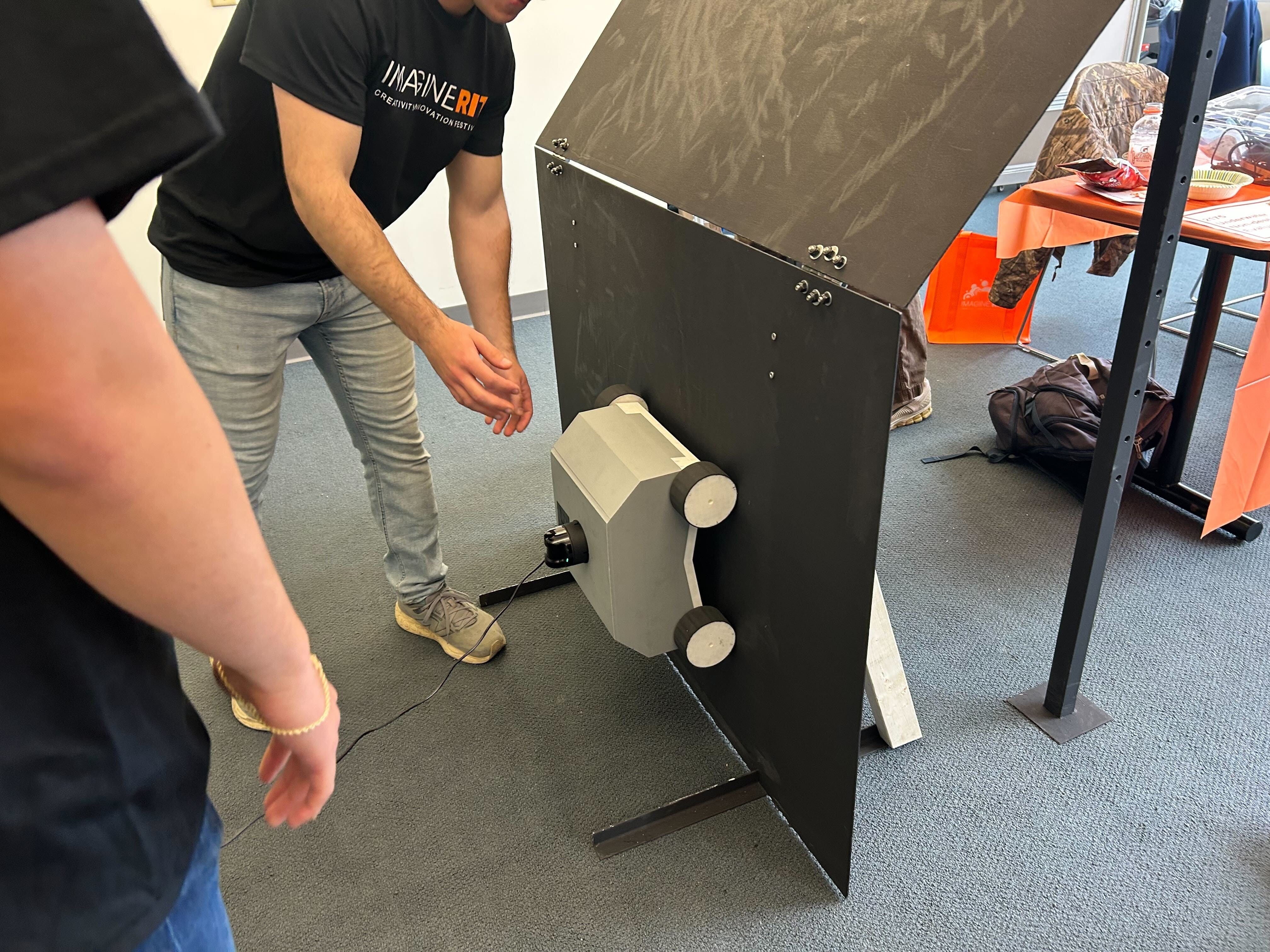
The prototype demonstrated at Imagine RIT was remotely controlled and tested on a rig representing a ship’s hull. The prototype used custom-made magnetic wheels to adhere to the test apparatus as it moved about. This approach, however, will see some modification in subsequent iterations. In a design review, Navy representatives pointed out that about 20% of its ships have aluminum hulls, which rule out the magnetic wheels.
Moving to modular
Based on the feedback, the team opted for a modular design. The plan is to swap out the magnetic wheels for thrusters for use with aluminum-hulled ships. A thruster consists of a propeller powered by an electric motor; a submersible robot can use one or more thrusters for propulsion.
Ryan Schaeffer, a member of the 2025-2026 UNDER team, said his group looked into thrusters from Blue Robotics. “We actually used the thrusters from Blue Robotics when modeling our modular design in CAD,” he said.
Another change in store for the prototype is a shift to actual underwater use.
“While we will be handing off the robot to next year’s team, I believe the biggest milestone we plan to hit next year is submersible deployment,” Schaeffer said. “With underwater usage possible, future teams will be able to test the robot directly on real ships in action.”
At that point, UNDER will shift from remote control to a combination of lidar, cameras, and sonar for autonomously navigating ships.
“Cameras and lidar would be particularly useful for work done above the waterline, and sonar would be key when submerged to allow the robot to ‘see’ through murky water,” Schaeffer said.
A role for AI
AI will play a role as well.
“AI will definitely also be a useful tool in this design as it will be used to help train the robot on how to interpret its surroundings,” he said. “When selecting a micro-computer to control the robot, we chose the Jetson Orin Nano particularly for its strong compatibility to interface with AI.”
A communication buoy will also be part of the UNDER setup. Schaeffer said underwater communication is difficult, noting that the only way to send data is through a tether with cables that directly transmit information back and forth. The idea is to run the tether to the buoy and, once the data reaches the buoy, send it wirelessly through the air to all affected parties, he noted.
Manufacturing prospects, technical influences
As UNDER makes the shift from prototype to production, the number of units to be deployed could range from 5 to 10 per ship. Jonathan Jacobs, a 2025-2026 UNDER team member, said the prototype’s housing was custom 3D printed. But once the design is completely finalized, the device could be sheet-metal stamped at scale to produce hundreds of robots quickly.
“The tooling for this is expensive, so the first metal housing prototype will likely be welded and machined so that tweaks to the design can easily be made,” Schaeffer said.
RIT’s efforts follow earlier developmental technologies such as the Navy’s Hull BUG, an autonomous hull groomer the service discussed in 2009. Such projects influenced UNDER.
“We definitely drew from the Hull BUG, as well as other robots like the HullWiper, when drafting our initial concepts,” Schaeffer said.
But the RIT team has benefited from technical evolution.
“I think the largest improvement that we have access to that was not available 17 years ago was the computing and navigation power that we have now,” Schaeffer noted. “With the power of the Jetson and more compact lidar and camera units, we can create a low-profile platform that is much more capable of autonomous navigation.”
Stability and renewal co-exist in established academic centers. This combination stands out as a top contribution to technology ecosystems: Schools like RIT offer continuity and historical perspective, while also benefiting from the constant influx of novel ideas that successive generations of students bring to the institution.